What's new
Run performance reviews with or without an AI-calculated rating
· For leaders and admins
An organization now decides whether the AI review comes with a calculated rating. Without one it is a written assessment of the evidence, and every score in a review comes from a person.
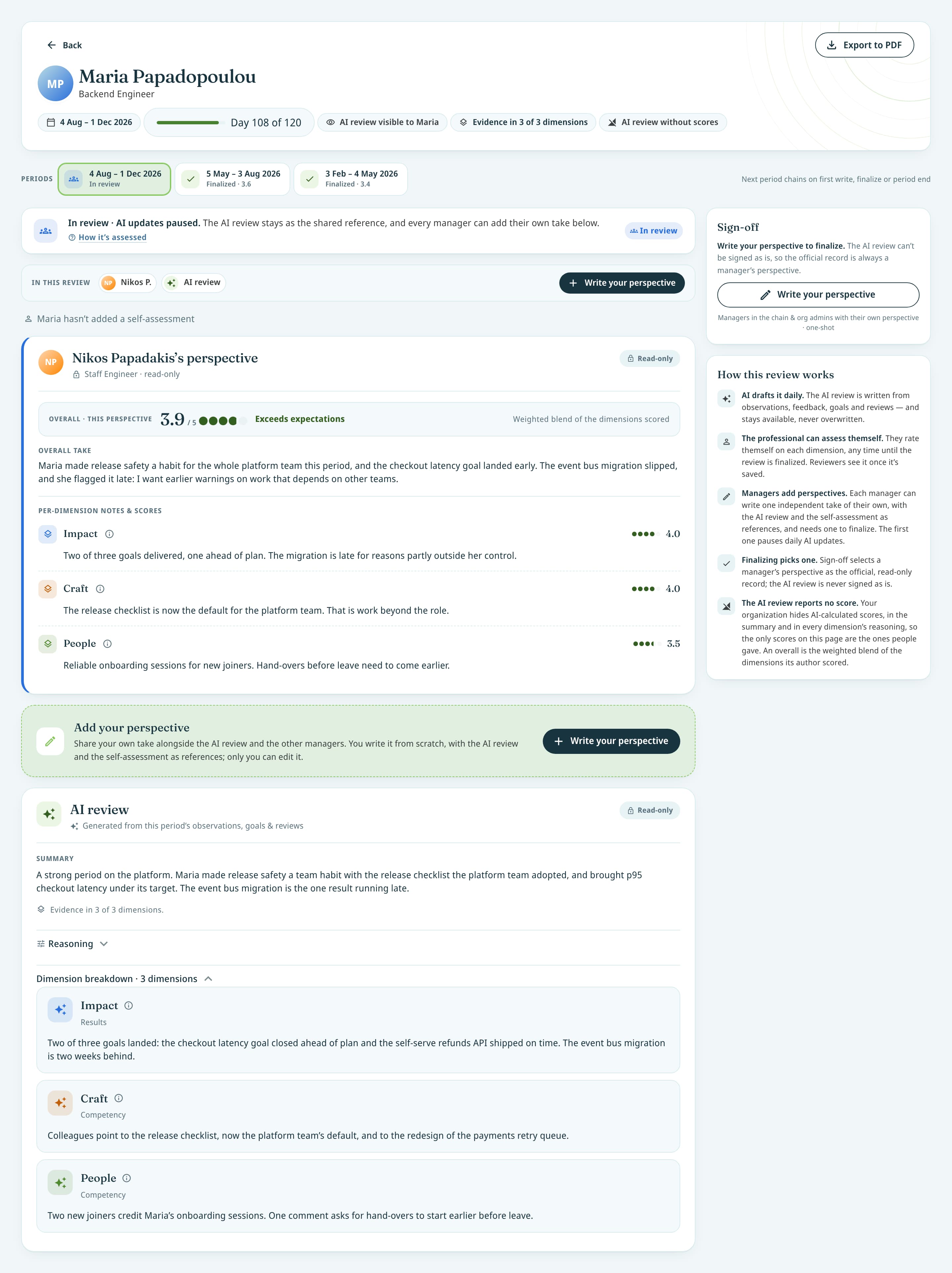
A rating from AI, or from people only
Until now, the AI review in every performance review came with a calculated rating: a score from 1 to 5 for each dimension of the framework, blended by weight into an overall, shown next to the scores leaders and professionals give. That stays the default.
An organization can now run its reviews without it. The AI review is then a written assessment: what the period's feedback, goals and dotsDot: Work worth talking about — time-bound, owned by whoever's doing it, open for conversation while it happens. show for each dimension, in words, with no number. Every score in the review is one a person gave.
When people-only ratings fit
- Leaders anchor on the number. A leader who opens a review that already says 3.8 has a rating in mind before reading a line of evidence. Without it, they read what the period showed and rate it themselves.
- Ratings are meant to come from people. A policy, or an agreement with employee representatives, can ask that ratings come from people, not from AI. The AI still gathers the evidence and writes it up; people do the rating.
- A first cycle. An organization new to evidence-based reviews can start with written assessments and add the calculated rating for a later cycle. It then appears on every review at once.
What a review looks like without it
- The AI review opens with a summary and writes up each dimension. It says how many dimensions the period evidenced, and names any it could not assess.
- A dimension's evidence is listed by the behaviour tier it matched and by its tone, without a level.
- Leaders' perspectives and self-assessments keep their scores from 1 to 5, and the framework's weights still blend them into an overall.
- A review has no headline score while it is open. Once signed, it shows the score of the perspective it was signed on.
- Profiles, the review timeline, the feedback overview and every PDF and Excel export follow: none shows an AI figure.
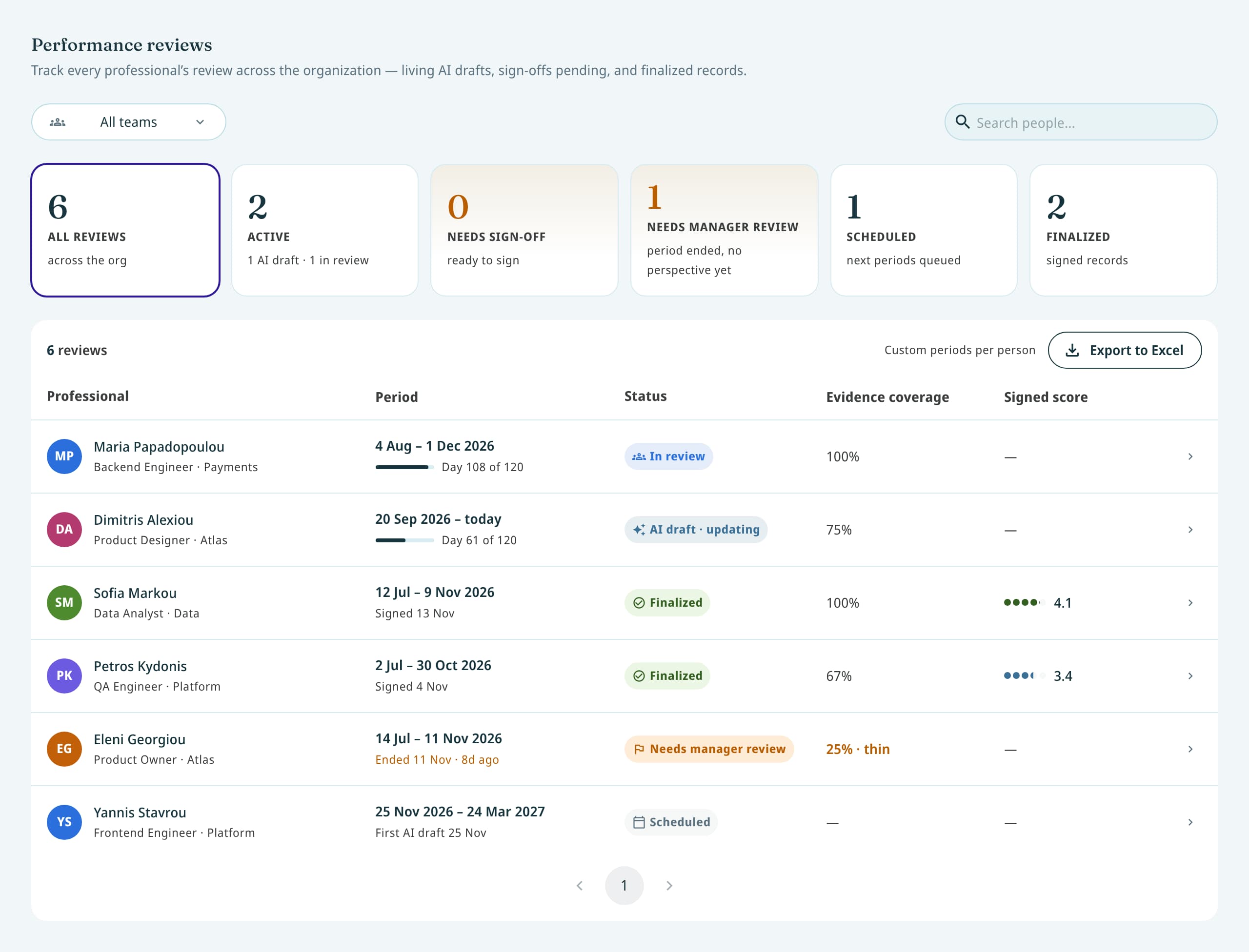
On the roster, each review shows its evidence coverage and its signed score, in columns that can be sorted. A review that has not been signed shows a dash, not an estimate.
What stays the same
With or without a calculated rating, the AI review is a draft that supports the leader, never the evaluation: a review is final only when a leader signs their own perspective. The rules on AI at work apply to it either way, and Evaluation setup now explains what they ask of an organization in the EU, the UK and the US.
Admins and moderators make the choice in Evaluation setup, for the whole organization, and can change it later. A confirmation lists what the choice changes before it applies.
And a few more
- On reviews without a calculated rating, How it's scored becomes How it's assessed, and says who gives a score.
- Text the AI wrote with its scores in it, before an organization made the change, is not shown, and a note says so.